Now in a brand new 30,000 sq. ft. facility. Same trusted service, greater capacity to support your next breakthrough.
Curved Array Probes
Specialized curved array transducers for wide-field imaging in constrained geometries
Sonele designs and manufactures curved array probes for imaging systems in compact, mechanically constrained environments, delivering consistent acoustic performance from prototype through scalable production.

Let’s bring consistency to curved field-of-view imaging
Curvilinear or convex array transducers need element uniformity, tuned acoustics, and robust interconnects that hold up in the lab and the field. We design and manufacture to those realities, from acoustic stack to housing.
Sonele optimizes the stack, lens, and electronics to provide ideal performance across depth, then validates with impedance, pulse-echo, and beam-profile data before you scale, under an ISO 13485 quality system in an FDA-registered facility.


Chris Bass
InventoRR MD, CEO

“It has been great working with Sonele. Their team has been extremely responsive and helpful in working with us to design AbClo into the great product it is today.”

A better partner for curved array transducers

ISO 13485–aligned manufacturing
Curved array builds run under an ISO 13485–aligned quality system with defined workflows, traceable materials, and controlled changes. This gives your team consistent performance and quality to support verification and regulatory work.

Full-range acoustic characterization
Performance is validated beyond on-axis measurements. Curved arrays are evaluated across the full angular range, with beam shape, sensitivity, and signal-to-noise ratio verified from near field to depth to reflect how the array is actually used in your imaging system.

Electrical integrity & serviceability
As element counts increase, signal integrity and mechanical reliability become harder to maintain. We design interconnects, shielding, and cable routing to keep signals clean while making probes easier to integrate, test, and service.

Geometry-aware validation
Our validation methods are designed to expose geometry-dependent effects. We combine electrical data, acoustic measurements, and application-relevant setups to see how curvature, element placement, and loading influence performance before probes reach system integration.
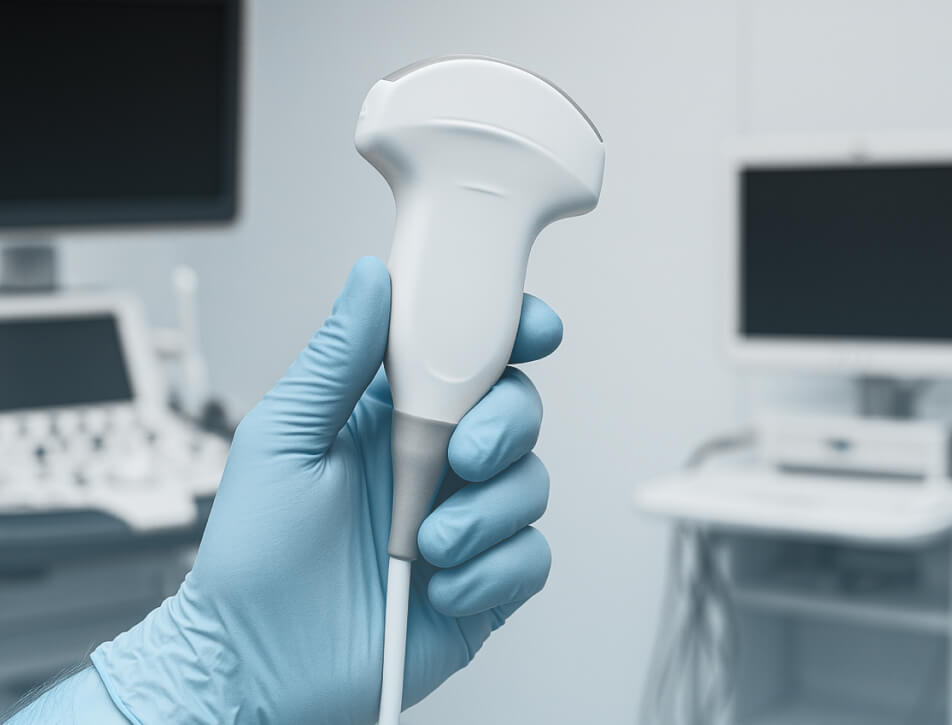
Tuned for uniformity across the curve
Curved arrays are highly sensitive to geometric variation. Small deviations in element position, curvature, or height can distort the beam, shift focus, and increase calibration efforts from one build to the next.
Sonele’s specialized curved arrays are engineered to maintain:
- Precise element placement along the curved aperture
- Consistent curvature and elevation across the active imaging field
- Uniform acoustic response from element to element
- Stable performance under mechanical, cable, and assembly loading
This results in repeatable imaging performance and predictable focusing, reducing calibration effort and simplifying system integration.

Curved array probes for specialized and emerging use cases
We do not ship one-size-fits-all convex array probes. Each curved array is built around a specific scan plan, patient access path, and system architecture, so you are not forcing a generic footprint into a workflow it was never designed for.
Endocavity & Endoscopic Imaging
Compact curved apertures designed to improve anatomical access and angular coverage in limited spaces.
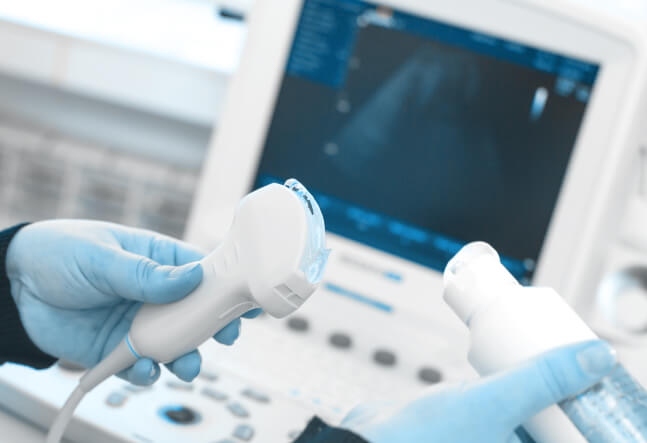
Intraoperative Imaging
Wide-field visualization for surgical settings where access, positioning, and line of sight are constrained.
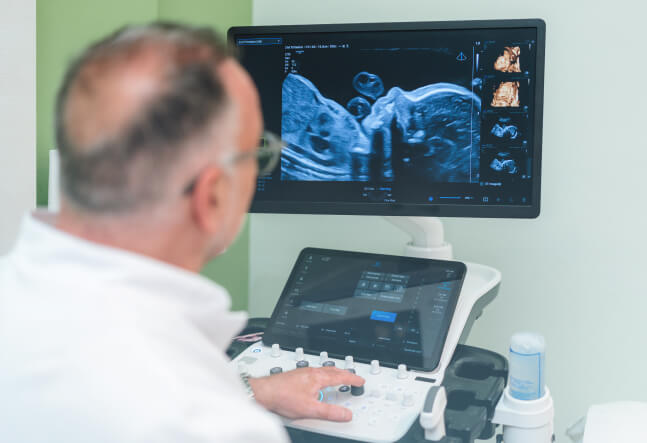
Integrated Imaging Systems
Curved arrays designed for systems that need to image around anatomy, tools, or structural obstacles.
OEM-Specific & Custom Designs
Curved arrays tailored to unique geometric, mechanical, and system-level constraints not addressed by standard catalog configurations.

Frequently asked questions
Yes. Sonele supplies curved arrays aligned to defined system constraints, including aperture geometry, element count, and interconnect configuration. This includes compatibility with your pinout, shielding approach, and cable interface to support clean system integration and bring-up.
Curved arrays are commonly used where wider field-of-view and angular coverage are required, including abdominal, endocavity, and intraoperative imaging.
At Sonele, curved arrays are most relevant in systems with constrained access, non-linear imaging geometry, or integration-driven design requirements.
Curved arrays are engineered to defined frequency targets based on application requirements. Design parameters such as stack configuration, backing, and lens geometry are selected to achieve the desired balance of penetration, bandwidth, and sensitivity.
Curved arrays are sensitive to geometric variation across the aperture. Sonele controls radius consistency, element spacing, and stack uniformity to support predictable acoustic performance across the sector.
Performance is verified through acoustic characterization, including beam profiling and response consistency across angles.
Yes. There is a lot of value in having Sonele manufacture the ultrasound system as well as the probes, including tighter final testing and integration, cleaner probe-to-console bring-up, and a single team responsible for system-level performance. Through our CDMO medical device manufacturing services, we can handle full-system assembly, verification, and production so you don’t have to manage multiple suppliers.
Standard curved probes are typically optimized for general imaging workflows. Limitations arise in systems with:
- Tight mechanical envelopes
- Complex cable routing or integration constraints
- Higher requirements for geometric consistency and repeatability
In these cases, variability in curvature, alignment, or interconnect can impact beam uniformity and system performance.
Sonele addresses this by aligning geometry, materials, and interconnect strategy to the specific application, rather than adapting a fixed probe format.
Our specialized curved arrays are built for medical device OEMs developing differentiated ultrasound systems, particularly where standard curved probes fall short. This includes applications with tighter mechanical constraints, complex routing, or higher performance requirements that off-the-shelf designs cannot reliably meet.
Contact Us
Ready to push the boundaries of medical technology?
The future of healthcare innovation starts here.
Fill out the form, and we will contact you within 3-5 days to start the process of bringing your breakthrough technology to life.