Now in a brand new 30,000 sq. ft. facility. Same trusted service, greater capacity to support your next breakthrough.
Linear Array Probes
Specialized linear array transducers for high-precision imaging applications
Sonele engineers linear transducer arrays with exceptional uniformity, optimized bandwidth, and advanced connectivity. Integrated for robotic, endocavity, minimally invasive, and integration-driven ultrasound systems, our arrays speed development without sacrificing precision.


Let’s set a new standard for linear array probe performance.
Linear array probes use a row of closely spaced elements to create high-resolution ultrasound images. They are commonly used for vascular, MSK, small-parts, and point-of-care imaging, where detail and uniformity across depth matter.
Too often, those arrays come with trade-offs in element uniformity, connectivity, or scalability. At Sonele, we engineer linear transducers that hold performance steady from the first prototype through volume production.
Our team brings industry-leading depth in acoustic stack design, microfabrication, and high-density array engineering. With in-house manufacturing, we deliver arrays with sharper imaging resolution, stable electrical performance, reliable thermal behavior, and consistent output at volume.

A better partner for linear array transducers

Geometric control
We control aperture, elevation, and element placement to tight mechanical tolerances so array geometry matches your models and housings. This supports tighter mechanical integration and repeatable performance across builds.

ISO 13485-certified
Our linear arrays are developed and built under an ISO 13485–certified quality system, ensuring the same controls apply from early engineering builds through to production. We provide Certificates of Conformance (CofC) with our delivered products.

Advanced interconnection strategies
We utilize high-density interconnect approaches, such as flex and rigid-flex, to maintain short, clean, and well-shielded signal paths. These strategies enable compact, non-traditional cable exits and handle designs without sacrificing signal integrity.

Scalable precision manufacturing
From early prototypes to thousands of units per month, our vertically integrated processes ensure your arrays are built with repeatable precision and ready to scale with demand.

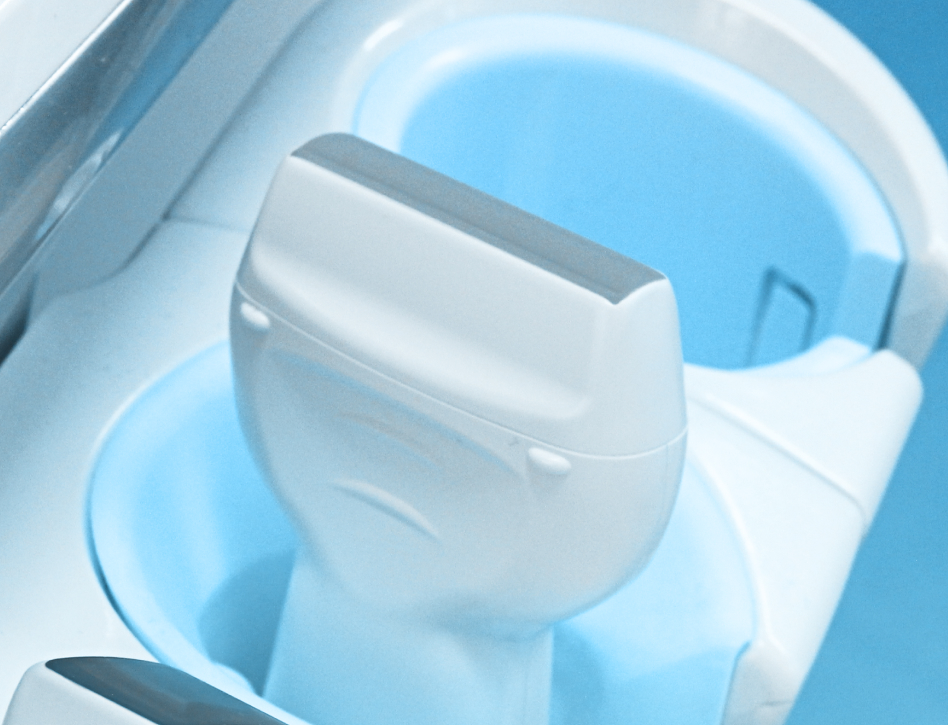
Tuned for precision and coplanarity
Linear arrays are highly sensitive to planar misalignment. Even minor deviations in coplanarity can introduce beam distortion, increase calibration burden, and drive build-to-build variability.
Sonele’s specialized linear arrays are engineered to maintain:
- Tight element coplanarity across the active aperture
- Consistent element spacing and alignment
- Uniform element-to-element acoustic response
- Stable performance under mechanical and assembly loading
This enables repeatable beam behavior, reduces downstream calibration effort, and simplifies system integration.

Linear arrays for specialized and emerging use cases
Our linear arrays are engineered to specific workflows and constraints, so specialized systems get predictable application-ready performance.
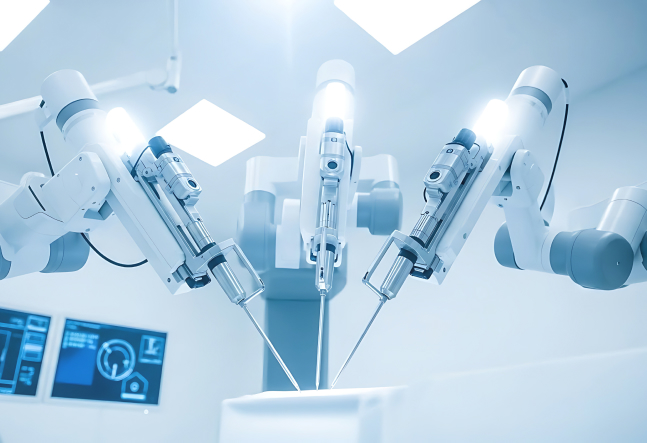
Robotic & Image-Guided Systems
Linear arrays optimized for integration into robotic end-effectors and automated scanning platforms, where positional accuracy, repeatability, and stable beam behavior are essential.
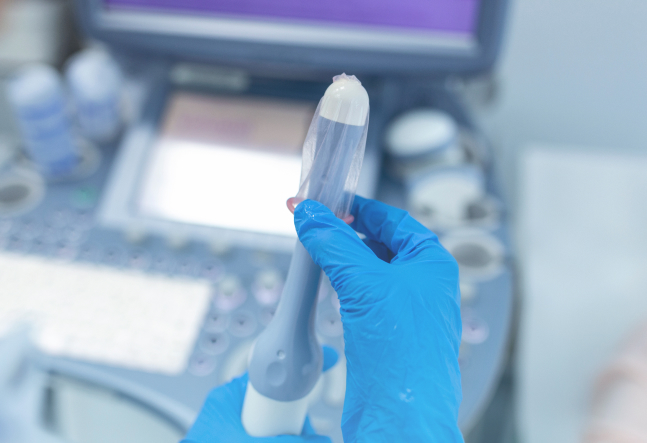
Endocavity & Endoscopic Imaging
Compact linear apertures designed for limited cross-sectional envelopes, tight routing constraints, and stable performance under mechanical stress (e.g., transrectal, transvaginal, interventional guidance).
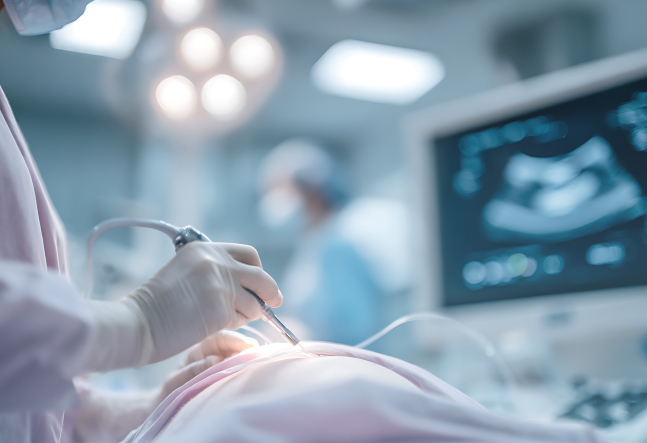
Intraoperative Imaging (Including Minimally Invasive Surgery)
Compact imaging arrays used during surgical workflows where reliability, consistency, and predictable beam behavior are required throughout the procedure.
OEM-Specific & Custom Designs
Linear arrays tailored to unique mechanical, electrical, and system-level constraints not available in the market.
Frequently asked questions
Yes. We build linear array transducers to your exact specifications, including frequency, aperture, element count, and interconnect strategy. Connector, pinout, and shielding are aligned to your system, and we provide the necessary build and test data to support electrical and acoustic integration.
Timelines depend on complexity and supply chain, but our model supports quick prototyping followed by controlled scale‑up; we’ve designed our operations to ramp within weeks to months while maintaining quality (process validation, trained operators, supplier coordination). This keeps production transitions fast without sacrificing compliance.
Yes. We work within your mechanical constraints to achieve a compact form factor without compromising acoustic performance or thermal management. Housing, interconnect, and assembly are developed together to ensure fit, durability, and manufacturability.
We support linear, phased array, and curvilinear probes. All programs follow the same engineering-led approach, from simulation and characterization through manufacturing and validation.
Yes. There is a lot of value in having Sonele manufacture the ultrasound system as well as the linear probes, including tighter system-level integration, final testing with the exact probes you plan to ship, and a single team responsible for performance from transducer to console. Through our CDMO medical device manufacturing services, we can support full-system assembly, verification, and production under an ISO 13485 quality system in an FDA-registered facility.
Standard linear arrays tend to fall short in robotic-assisted, endocavity, and minimally invasive systems where integration constraints are extreme. Very small cross-sectional envelopes, tight bend radii, cable strain limits, high channel counts, and maintaining coplanarity under mechanical and assembly stress all push beyond what generic catalog arrays were designed to handle.
We begin by defining application and system constraints, then evaluate feasible configurations using simulation and theoretical performance modeling. From there, we fabricate prototypes, validate acoustic performance, and refine as needed against defined targets.
The final step is a controlled transition to production, ensuring performance, integration, and consistency are maintained at scale.
Our specialized linear arrays are built for medical device OEMs developing differentiated ultrasound systems, especially in robotic, endocavity, and intraoperative applications. This is a fit when standard probes cannot meet mechanical, routing, or system-integration requirements.
Contact Us
Ready to push the boundaries of medical technology?
The future of healthcare innovation starts here.
Fill out the form, and we will contact you within 3-5 days to start the process of bringing your breakthrough technology to life.