Now in a brand new 30,000 sq. ft. facility. Same trusted service, greater capacity to support your next breakthrough.
Clinical Validation Testing for Medical Devices
Demonstrate that your medical device meets its requirements and performs as intended.
Sonele integrates risk-based medical device validation testing, verification, planning, test-method development, documentation, and third-party laboratory coordination into the medical device development process.
Our engineering and manufacturing teams help customers generate objective evidence, resolve technical issues, and prepare V&V documentation for regulatory submissions, design transfer, and commercialization.


Let’s build the evidence your device needs to move forward.
Medical device verification and validation testing are only as strong as the foundation behind them, including clear requirements, appropriate test methods, representative test articles, defined acceptance criteria, and strong traceability. Without this foundation, testing can produce data without providing clear objective evidence.
Sonele connects V&V directly to risk management, engineering, prototyping, and manufacturing to keep programs aligned from initial requirements through testing and design changes. This continuity supports efficient investigation, redesign, sample rebuilding, and retesting when needed.


Chris Bass, CEO
InventoRR MD

“It has been great working with Sonele. Their team has been extremely responsive and helpful in working with us to design AbClo into the great product it is today.”

What sets our medical device testing and validation apart

Early integration
The testing strategy is defined during design. Our engineers identify performance risks, documentation gaps, and process concerns at the stage where they are still inexpensive to resolve.

No silos
Testing at Sonele is connected directly to design, engineering, and manufacturing. When something doesn’t pass, the same team that built it resolves it.

Regulatory-ready docs
Every test produces documentation aligned with your regulatory pathway: test data, process validation reports, traceability records, and design history file contributions, produced throughout the program.

End-to-end
Sonele supports prototype functional testing, design verification, and IQ/OQ/PQ process validation through manufacturing transfer and commercial production readiness.
Our testing and validation capabilities

Functional, Performance & Reliability Testing
Sonele develops and performs device-specific testing to support verification and validation based on intended use, technical requirements, identified risks, and stage of development.
- Functional performance testing: Evaluation of devices, subsystems, and assemblies.
- Mechanical testing: Assessment of dimensions, tolerances, and mechanical performance.
- Electrical testing: Evaluation of electronics and system functionality.
- Reliability testing: Assessment of durability and lifecycle performance.
- Environmental testing: Evaluation under defined and simulated-use conditions.
- Process validation: Reducing risks associated with manufacturing processes whose outputs cannot be fully verified without destructive testing.



Ultrasound System Testing & Characterization
Sonele supports V&V testing and characterization of diagnostic, therapeutic, and research ultrasound systems.
- System testing: Evaluation of complete systems and critical subsystems.
- Acoustic characterization: Measurement of output, hydrophone data, and beam profiles.
- Integration testing: Assessment of transducer and electronics performance.
- Reliability testing: Evaluation of thermal and lifecycle performance.
- Failure analysis: Investigation of issues and test method development.
Third-Party Testing & Certification Support
Sonele helps customers prepare for and coordinate independent testing and certification activities while supporting the technical process.
- Test planning: Identification of requirements and external testing needs.
- Sample preparation: Configuration and documentation of test samples.
- Issue resolution: Investigation of findings and design support.
- Retesting support: Coordination of sample rebuilding and final documentation.
- Certification support: Coordination of safety, EMC, and regulatory testing, including assistance in identifying the appropriate standards.


How we support medical device verification and validation testing
01
Requirements & Risk Review
Establish a clear foundation for V&V by defining the requirements, risks, and objectives the program must demonstrate.
- We review user needs, design inputs, risk controls, standards, and project requirements to define V&V objectives.
- Requirements and risks are aligned early to support effective test planning, traceability, and documentation.


02
V&V Planning
Define the verification and validation activities needed to demonstrate device performance and compliance.
- We establish test methods, acceptance criteria, sample requirements, responsibilities, and documentation needs.
- V&V plans are developed to align with the device, regulatory pathway, and overall project scope.
03
Test Method & Fixture Development
Create reliable testing approaches that generate accurate and repeatable results.
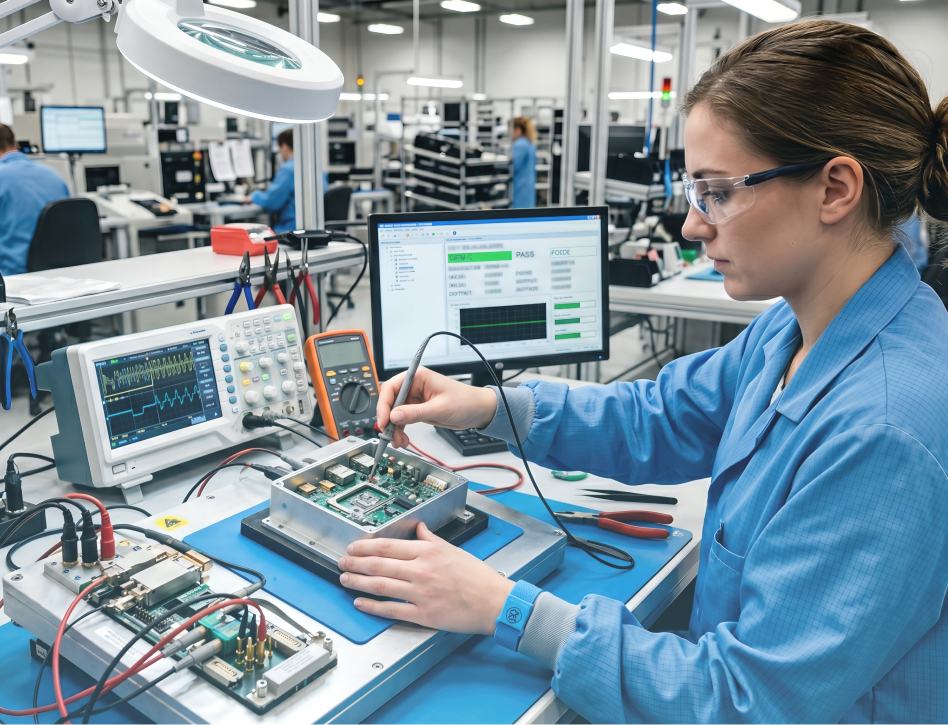
- We develop device-specific test procedures, fixtures, measurement systems, and supporting software.
- Test methods are validated where required to ensure suitability for the intended evaluation.

04
Test Article Preparation
Produce traceable test articles that represent the device design and intended manufacturing process.
- We produce or coordinate traceable test articles in the required configurations and specifications.
- Samples are prepared to reflect the final design and intended production process where applicable.
05
V&V Execution & Documentation
Perform controlled testing and generate objective evidence to support regulatory and development milestones.
- We perform or coordinate V&V activities using documented procedures and defined acceptance criteria.
- Results are documented and maintained with traceability to requirements, risks, and design inputs.


06
Issue Investigation & Retesting
Resolve unexpected results and support improvements needed to meet acceptance criteria.
- We investigate failures and support design refinements, corrective changes, and retesting.
- Findings are incorporated into the V&V record to maintain traceability throughout development.
07
Final Documentation & Design Transfer Support
Prepare the records and evidence required for design transfer and manufacturing readiness.
- We finalize protocols, reports, deviation records, configuration records, and traceability documentation.
- V&V evidence supports design transfer, production testing, and manufacturing controls.

Frequently asked questions
Design verification confirms that design outputs match design inputs: the device was built according to its specifications. Design validation confirms that the finished device performs correctly for its specific intended use, tested under actual use or simulated conditions with real users. Both are required under design controls, and both contribute to the documentation package your regulatory submission requires. Sonele supports both within the same integrated development program.
Our program is structured around the design controls and regulatory standards that apply to your device class and target market. Throughout development, we produce objective evidence that your device meets its design requirements and intended purpose, including test reports, validation records, and traceability matrices. This documentation supports submissions to the FDA, Health Canada, and CE Mark, maintained within our ISO 13485-certified quality system.
Sonele performs functional and performance testing against design inputs, prototype verification, design validation under actual use and simulated environments, and IQ/OQ/PQ process validation. For connected and software-enabled devices, we also support software validation activities. Where specialized third-party testing is required, such as sterilization validation, we coordinate with qualified partners.
Usability testing at Sonele focuses on how real users interact with your device in clinical environments. We gather structured feedback under simulated use conditions, identify user errors and pain points, and translate those findings into design improvements before they become costly to address. This work supports design validation requirements and contributes to the risk management documentation that your regulatory submission requires.
Because testing runs within the same program as design and manufacturing, a failed result feeds directly back into the engineering team. We identify whether the issue traces to materials, process parameters, or unmet design requirements, and resolve it within the same program. That structure reduces the time and cost of getting back on track compared to managing failures across separate organizations.
IQ/OQ/PQ process validation confirms that your manufacturing processes produce consistent, repeatable results before market entry. It verifies that equipment, processes, and procedures perform as required under production conditions, generating the objective evidence needed to demonstrate that device performance will be consistently fulfilled at scale. That work is a direct prerequisite for commercial production and supports ongoing post-market surveillance requirements.
As early as possible. The most expensive testing problems trace back to decisions made during design. Engaging Sonele early means the test strategy, design controls, and documentation approach are defined alongside the device architecture, not after it. Medical device verification and validation testing is significantly more efficient when it informs design rather than auditing it.
Yes. We can review existing documentation, identify gaps relative to your regulatory standards and design requirements, and support the remaining verification and validation activities. Whether you need support for a specific phase or a broader review of your V&V program, our team can engage at whatever stage your program is at.
Risk management is integrated into our testing program from the start. We conduct structured effects analysis to identify potential risks across device functions and use scenarios, implement appropriate controls, and verify their effectiveness through testing. That process generates objective evidence that safety has been adequately addressed before the device reaches clinical environments.
The documentation produced throughout our program, including test reports, validation records, and traceability matrices, establishes the baseline needed for post-market surveillance after market entry. Because our quality system maintains structured records across development and production, identifying and responding to field performance issues is supported by a clear, traceable history of how the device was tested and validated.
Contact Us
Ready to take your device through testing and into market?
Tell us about your device, and we’ll be in touch to discuss your testing and validation needs.